


Two people can ask about eye-corner surgery in Korea and mean very different procedures. One may be concerned about the inner fold. Another may want to understand the outer eye corner. Patients comparing epicanthoplasty and lateral canthoplasty in Korea need different surgical plans, not a generic eye-enlargement package.
If you're researching epicanthoplasty in Korea, compare its goals, risks and recovery with lateral canthoplasty before travelling. If you are comparing actual service options, explore Eye-Corner Surgery in Korea on Fornur.
 Quick Answer: Epicanthoplasty vs Lateral Canthoplasty
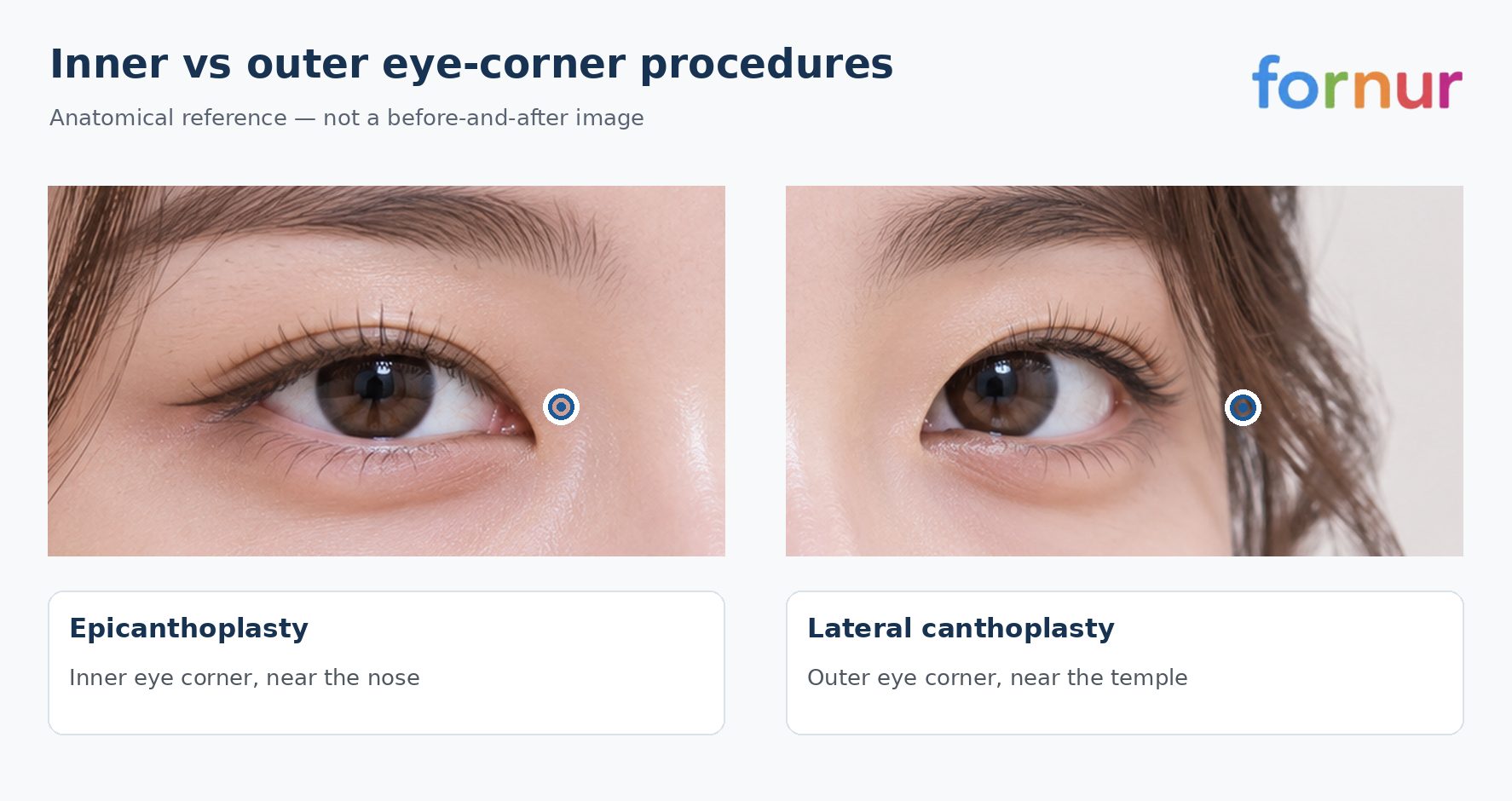
Epicanthoplasty modifies skin and soft tissue around the inner eye corner, often reducing a prominent epicanthal fold. Lateral canthoplasty modifies the outer corner or its supporting structures. Neither procedure is simply a different name for double-eyelid surgery.
• Epicanthoplasty: The main area is the inner eye corner, beside the nose.
• Lateral canthoplasty: The main area is the outer eye corner, beside the temple.
• Double-eyelid surgery: The main goal is creating or defining an upper-eyelid crease.
• Lower blepharoplasty: The main concern is often under-eye bags, skin or fat distribution.
These procedures may be discussed together, but they are not interchangeable. A qualified surgeon should explain whether any additional operation is necessary.
What Is Epicanthoplasty?
An epicanthal fold is a normal anatomical feature that partly covers the inner eye corner. Its size and shape vary between individuals. Having this fold does not mean treatment is medically necessary.
Epicanthoplasty, sometimes called inner-corner surgery, modifies the fold or its underlying tension. The goal must be personalised rather than copied from a photograph.
Published surgical techniques include skin redraping and Z-plasty variants. The choice depends on anatomy, desired change, scar placement and the surgeon's assessment. A 2025 review of epicanthoplasty scar-minimising approaches considered skin redraping versatile but acknowledged limited comparative evidence.
A 2026 meta-analysis of skin redraping versus Z-plasty reported better six-month scar scores and patient satisfaction with Z-plasty. The included studies were Chinese-language, techniques varied, and follow-up was short. The results do not establish a universally best method or scar-free outcome. They cannot predict results at an individual Korean clinic.
How Is Lateral Canthoplasty Different?
Lateral canthoplasty focuses on the outer eye corner and its supporting tissues. It may be considered for selected functional or cosmetic concerns. The precise operation depends on eyelid position, tension and eye-surface protection.
The outer corner helps maintain eyelid support and proper closure. Changing it can affect blinking, lower-lid position and comfort. These are functional considerations, not just cosmetic details.
A review of common oculoplastic procedures describes both epicanthoplasty and lateral canthoplasty as distinct surgical categories. It also highlights variations in technique and outcomes.
Do not assume an advertised 'eye enlargement' package means both procedures are suitable. Ask the surgeon to name the operation and justify it.
Canthoplasty vs Canthopexy: Why the Difference Matters
Canthopexy tightens or supports the outer eyelid without detaching the lateral canthal tendon. Canthoplasty can involve more extensive reconstruction or repositioning.
The appropriate method depends on eyelid position, laxity and eye-surface protection. Ask the surgeon to name the planned technique.
A peer-reviewed review of lateral canthal tightening describes why surgeons select different techniques.
Which Procedure Matches Your Concern?
The first question is not which procedure is more popular. It is which part of the eyelid creates the concern.
• Inner fold covers part of the inner eye corner: Ask whether epicanthoplasty is relevant.
• Outer eye corner position or eyelid support: Ask about lateral canthoplasty or another specific correction.
• Upper-eyelid crease or asymmetry: Compare Double Eyelid Surgery in Korea before considering additional eye-corner work.
• Lower-eyelid bags or excess skin: Review Lower Blepharoplasty in Korea, a separate procedure.
Dryness, difficulty closing the eyes, previous surgery or unusual tearing deserve careful assessment. An ophthalmologist or oculoplastic specialist may be appropriate.
Can Epicanthoplasty Be Combined With Double-Eyelid Surgery?
Sometimes. An upper-eyelid crease procedure and inner-corner surgery may be planned together for selected anatomical goals. However, their indications remain distinct.
Adding another operation increases the areas that must heal. It may also introduce separate scarring and complication risks. The surgeon should explain what changes with and without the extra procedure.
Our Double Eyelid Surgery Korea guide compares buried-suture, small-incision and full-incisional crease methods. It does not treat canthoplasty as an automatic upgrade.
Scars and Risks: What Should You Understand?
Any eye-corner incision can leave a scar. Visibility depends on incision placement, skin healing, tension, previous surgery and other individual factors.
Epicanthoplasty risks include noticeable scarring, asymmetry, undercorrection, overcorrection and recurrence. Nearby tear-drainage structures also need protection. Published reviews describe scar management as a central surgical consideration.
Lateral canthoplasty carries different concerns. These may include lower-eyelid malposition, irritation, tearing, poor lid closure and exposure of the eye surface. The surgical team must assess eyelid support and ocular health.
Both procedures can cause swelling, bruising, infection or an unsatisfactory cosmetic result. Rare complications may require additional medical or surgical care.
Seek urgent medical evaluation for sudden vision changes, severe eye pain, or rapidly increasing swelling. These are not symptoms to manage through a routine cosmetic follow-up.
Recovery After Eye-Corner Surgery in Korea
Recovery depends on the exact technique, whether procedures are combined and your healing. Do not rely on a fixed 'downtime' promise.
The first several days
Swelling, bruising, tenderness and wound care are common early concerns. Ask which medications, dressings and restrictions apply to your operation.
The first one to two weeks
Some visible swelling may improve, but the area can still be tender or uneven. If stitches require removal, schedule that review before booking travel.
The following months
Scar colour and tissue firmness can continue changing for months. Early photographs are not reliable proof of a final surgical result.
General NHS eyelid surgery guidance discusses recovery and complications. However, your surgeon's procedure-specific instructions take priority.
How Much Does Epicanthoplasty Cost in Korea?
There is no verified single national price for epicanthoplasty or lateral canthoplasty. A quote can vary with the procedure, revision history, surgeon, facility and aftercare.
Request the exact operation name and an itemised quote. Confirm whether anaesthesia, tests, medicines, stitch removal and follow-up visits are included.
If another procedure is proposed, ask for separate and combined prices. Our Plastic Surgery Cost in Korea guide explains how to compare surgical quotes.
Avoid transferring prices from double-eyelid surgery or another clinic to eye-corner surgery. They are not interchangeable services.
Comparing eye-corner surgery costs? Explore the Eye Surgery treatment overview on Fornur. Confirm current availability, the exact technique, surgeon and complete written quote before committing.
What Should You Check in Before-and-After Photos?
Photos can help you understand a surgeon's approach, but they cannot guarantee your result. Similar camera angles and lighting make comparisons more useful.
• Compare patients with similar starting anatomy and stated procedures.
• Ask whether double-eyelid surgery or another operation was performed at the same time.
• Check when photographs were taken, especially before scars have matured.
• Ask whether any revision or additional treatment occurred.
Do not treat AI-generated or illustrative images as real surgical outcomes. Request genuine, appropriately consented clinical examples from the provider.
Questions to Ask a Seoul Eye-Surgery Clinic
• Which exact anatomical concern are you treating, and why?
• Do I need epicanthoplasty, lateral canthoplasty or neither?
• Who is the operating surgeon, and what is their relevant experience?
• How will you protect eyelid closure, the ocular surface and tear drainage?
• Where will the scars be, and how are complications managed?
• How many review visits and which stitch-removal arrangements are required?
• What is the full written cost, including any combined procedures?
• What happens if I need follow-up after returning home?
For international patients, check the Medical Korea registered-hospitals directory. Registration is a verification step, not a guarantee of clinical outcome.
 Planning Treatment and Travel Through Fornur
Research the surgeon and the exact procedure before choosing travel dates. The NHS guidance on cosmetic surgery abroad explains why aftercare matters.
You can explore Fornur's Eye-Corner Surgery treatment page or browse Plastic Surgery in Korea. These pages are informational and do not confirm immediate appointment availability.
Consultation and reservation support depend on Fornur's current registration and partner availability. Confirm the actual enquiry process before making travel arrangements.
The Bottom Line
Epicanthoplasty concerns the inner corner; lateral canthoplasty concerns the outer corner and its support. Neither should be chosen by a package label alone.
A sound decision starts with anatomy, a qualified surgeon and realistic expectations. Compare scars, functional risks, recovery and complete costs before committing.
Ready to compare your options? Ask Fornur about current eye-corner surgery enquiry availability on WhatsApp. Availability and bookings must be confirmed before planning travel.
How This Guide Was Prepared
This guide is designed to help foreign residents and visitors understand common questions before making a decision. Details should always be confirmed directly with the relevant provider or an appropriately qualified professional.
- Author
- Mustafa
- Last reviewed
- November 10, 2026