

Men's rhinoplasty is not about giving every patient the same nose. You might want to address a prominent bridge, a drooping tip, an old injury or difficulty breathing. Each concern requires a different assessment and possibly a different operation.
For men researching nose surgery in Korea, the useful question is not which clinic promises the sharpest profile. It is which surgical changes fit your anatomy, goals and long-term nasal function.
This guide explains options, realistic recovery, pricing factors and how to compare Seoul clinics. For current rhinoplasty information and available enquiry options, explore Fornur Rhinoplasty & Nose Surgery before deciding whether to contact Fornur. A listed treatment is not a confirmed clinic booking.
 Quick Answer: What Is Men's Rhinoplasty?
Men's rhinoplasty is nose reshaping planned around a male patient's individual anatomy, preferences and functional concerns. Surgery may adjust the nasal bridge, tip, nostrils or internal structures. Some patients seek cosmetic changes, while others need assessment after injury or for breathing symptoms.
There is no medically correct 'male nose' and no guaranteed outcome. A 2024 clinical review of contemporary male rhinoplasty stresses careful assessment and consultation, rather than a one-size-fits-all approach.
A useful starting point: name the one or two features that concern you, and ask what changes are achievable without compromising breathing.
What Makes Male Rhinoplasty Planning Different?
People often describe men's rhinoplasty as keeping a 'masculine' profile, but that is a personal preference, not a clinical rule. Some patients prefer a straighter bridge or less tip rotation. Others want to keep an existing dorsal contour while correcting asymmetry or an injury.
A surgeon should examine the whole nose and its relationship to the face. Skin thickness, cartilage strength, existing asymmetry, breathing and previous procedures can influence the plan.
The 2020 male rhinoplasty clinical review discusses the importance of precise planning and clear expectations. Neither review establishes one ideal shape for all men.
Which Nose Concerns Can Surgery Address?
A prominent hump or uneven bridge
A dorsal hump is a raised contour along the nasal bridge. Reduction may involve bone, cartilage or both. In selected cases, preservation techniques may be considered. The correct approach depends on anatomy and surgeon evaluation.
A drooping, wide or poorly supported tip
Tip surgery may change cartilage shape or support. Tip projection, rotation and symmetry must be assessed together. A smaller tip is not automatically a better-supported tip.
A crooked nose after an injury
Trauma can affect the nasal bones, septum or both. Correcting the appearance may not resolve obstruction unless the internal airway is also assessed. Bring details of previous injuries and operations to the consultation.
A low or narrow bridge
Selected patients may discuss augmentation using cartilage or an implant. Materials have different benefits, limitations and risks. Ask why a particular material is proposed and how complications or revision would be handled.
Nostril width or alar-base concerns
Nostril and alar-base surgery targets different structures from bridge or tip surgery. Ask where incisions and scars would be placed, whether the airway may be affected and what degree of change is realistic.
These concerns are examples, not a checklist of procedures to combine. The American Academy of Facial Plastic and Reconstructive Surgery explains that nasal surgery can involve both cosmetic and functional changes.
Men's Rhinoplasty and Breathing: Cosmetic Surgery Is Not the Whole Story
A crooked external nose, nasal obstruction and a deviated septum are related possibilities, not interchangeable diagnoses. Persistent congestion may also have non-surgical causes, including allergies.
Functional assessment may examine septal deviation, nasal-valve support and other airway problems. When appropriate, a clinician might discuss septoplasty, functional rhinoplasty or combined surgery.
Tell the surgeon which side feels blocked, whether symptoms change during exercise or sleep, and whether you have previously injured your nose. The NHS rhinoplasty guidance describes breathing changes as an important consideration and potential complication.
Open vs Closed Rhinoplasty: Which Is Better for Men?
Open and closed rhinoplasty describe surgical access, not a ranking of quality. An open approach commonly involves a small incision across the columella between the nostrils. A closed approach typically uses incisions inside the nose.
The choice depends on the required structural work, visibility, scars, revision history and surgeon experience. Neither method is universally safer, faster or more 'masculine'.
Ask the surgeon to describe the intended changes using your own clinical photographs, not only generic before-and-after examples.
Men's Rhinoplasty Cost in Korea: What Changes the Quote?
A reliable quote should describe a specific operation. There is no defensible nationwide price for all male rhinoplasty in Korea, and a starting figure cannot represent the total cost of surgery abroad.
The main cost drivers include:
Primary surgery versus revision surgery, especially after previous grafts, fillers or trauma.
Bridge, tip, septal, alar-base or combined structural work.
Surgeon, facility, anaesthesia and operating-time requirements.
Cartilage harvesting, implant or graft materials when applicable.
Investigations, prescriptions, postoperative reviews and management of complications.
Translation, local accommodation, transport and any additional stay required.
Ask for a written, itemised price and whether follow-up appointments are included. For a broader budgeting framework, read Fornur's Plastic Surgery Cost in Korea guide.
NEXT STEP - Review the Rhinoplasty & Nose Surgery treatment page for current service information. Ask if Fornur can handle male-rhinoplasty enquiries and whether a surgeon can confirm the proposed operation, itemised cost, reviews and complication policy. Do not treat a page visit or enquiry as a confirmed booking.
Recovery After Male Rhinoplasty: A Realistic Timeline
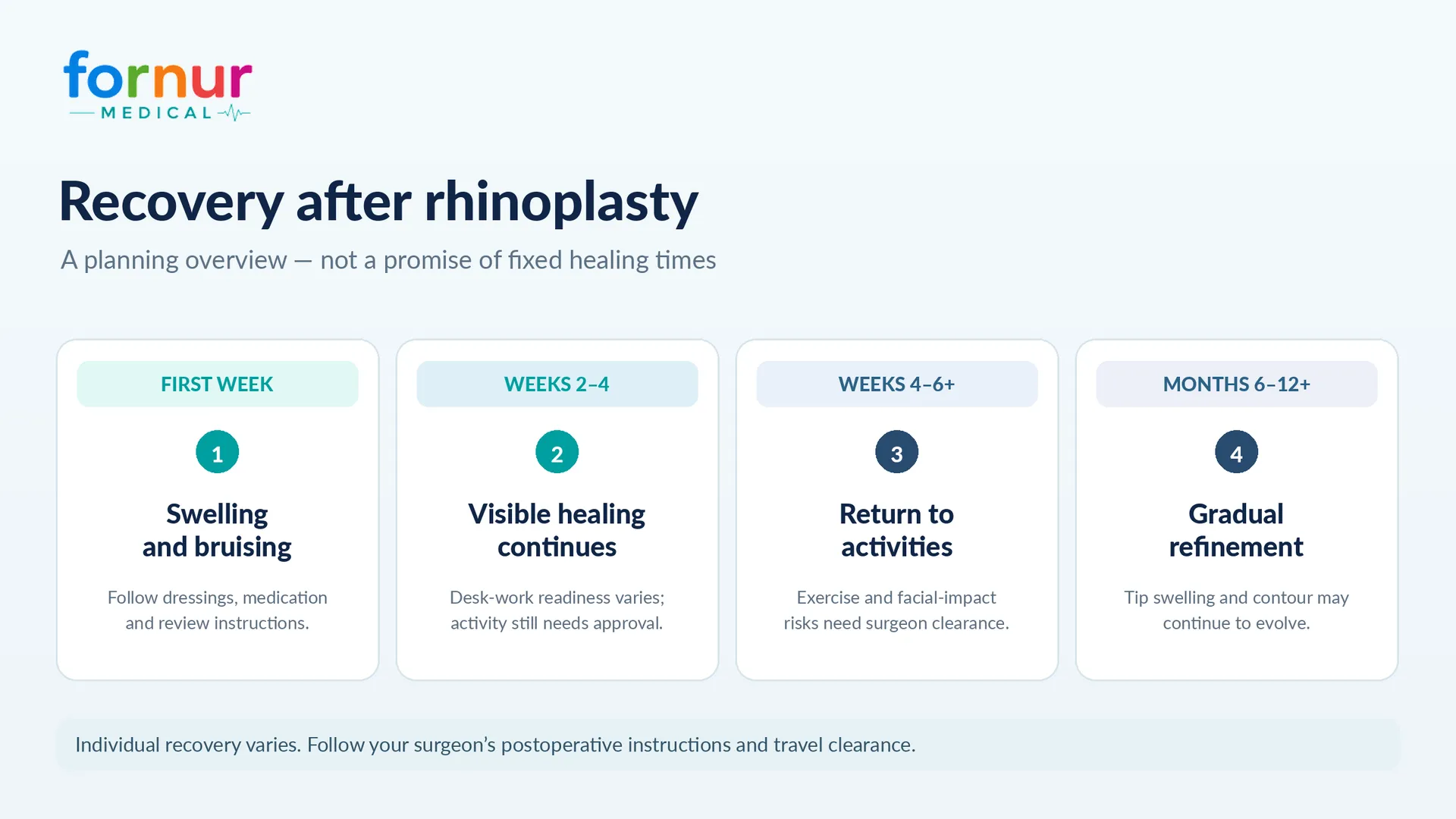
Recovery is individual. The procedure, tissue response and your surgeon's aftercare instructions determine the safest schedule. The American Society of Plastic Surgeons explains that swelling can continue to change over many months.
First week
Swelling, congestion, bruising and discomfort are common. Splints or dressings may be used. Follow instructions on medications, nasal care, sleeping position and review appointments.
Weeks two to four
Some people return to desk work as visible swelling improves. Others need longer, particularly after extensive or combined surgery. Do not confuse being able to work with having fully healed.
Four to six weeks and beyond
Exercise, contact sports and activities risking facial impact need individual clearance. The NHS discusses several weeks of restriction for strenuous activity. Do not use a fixed date without your surgeon's approval.
Several months to a year
Residual swelling, especially around the tip, may continue to settle. Final refinement can take up to a year or longer in some circumstances. Early photographs do not show the final outcome.
Travel is part of recovery planning. The CDC highlights postoperative flight-related risks and reports professional advice to wait approximately 7–10 days after certain facial cosmetic procedures before flying. That is general guidance, not individual clearance or a guaranteed safe flight date.
Risks and Limitations Worth Discussing Early
Rhinoplasty can cause bleeding, infection, anaesthesia-related complications, scars, altered sensation, asymmetry, breathing problems or the need for further surgery. Previous injury, fillers or surgery can complicate planning.
A surgeon should explain realistic benefits, alternatives, recovery, revision possibilities and how postoperative problems would be managed. The NHS lists important rhinoplasty complications and emphasizes that results cannot be guaranteed.
Nose fillers do not shrink bone or cartilage or correct a structural breathing problem. They also carry serious vascular risks, including rare tissue injury or vision loss if filler enters a blood vessel. Read the FDA's dermal-filler safety guidance before considering an injectable alternative. Fillers should not be presented as a simple replacement for surgery.
How to Choose a Rhinoplasty Surgeon or Clinic in Korea
Start with the clinician and surgical plan, not a package headline or filtered photograph.
Verify the surgeon's identity, relevant specialist credentials and direct involvement in the operation.
Ask to review comparable cases, including realistic results and how photographs were captured.
Confirm the full facility and anaesthesia team, not just the consultation office.
Discuss internal breathing assessment, specific surgical steps and material choices.
Request complication, revision and aftercare policies in writing.
Check language support, who to contact after hours and follow-up after you return home.
Korea's official Medical Korea registration system provides information on registered institutions serving foreign patients. Confirm the specific clinic's current registration instead of assuming every advertised clinic is approved.
The CDC's medical tourism guidance advises travelers to check credentials, follow-up care and the risks of combining surgery with international flights. Accreditation alone cannot promise a particular outcome.
Practical Consultation Checklist for International Patients
Before comparing quotes, prepare a concise list of questions:
What exactly do I want changed, and which features do I prefer to keep?
Is my concern cosmetic, related to breathing or both?
Which structures would be operated on? Are grafts or implants proposed?
How many similar procedures has the operating surgeon performed?
What are my personal risks, scar locations and realistic limitations?
How many postoperative visits do I need before leaving Seoul?
What is included in the full quote, and what happens if complications arise?
How will follow-up work after I return to my home country?
If you are still researching broader bridge, tip and graft terminology, use Fornur's Asian Rhinoplasty in Korea guide. It covers the general surgical concepts without duplicating the male-specific decisions here.
NEXT STEP - Browse Fornur Plastic Surgery treatments and check Fornur's contact details to ask whether male-rhinoplasty enquiries are currently supported. Share your general goals and approximate travel window; discuss sensitive medical details only through an appropriate clinical channel. No clinic match or appointment is guaranteed.
The Bottom Line
The best men's rhinoplasty plan is one that fits your own nose, breathing, goals and recovery needs. A polished appearance is not a substitute for a safe procedure or a clear postoperative plan.
Compare the proposed surgery, operating surgeon, recovery plan and full cost. Explore Fornur's Rhinoplasty & Nose Surgery information to review Fornur's current service details. Confirm the available enquiry route before paying a deposit or arranging travel.
Medical note: This guide is educational and does not provide a diagnosis, treatment recommendation, quote or confirmed booking. A properly qualified clinician must assess individual suitability and risks.
How This Guide Was Prepared
This guide is designed to help foreign residents and visitors understand common questions before making a decision. Details should always be confirmed directly with the relevant provider or an appropriately qualified professional.
- Author
- Mustafa
- Last reviewed
- November 12, 2026