
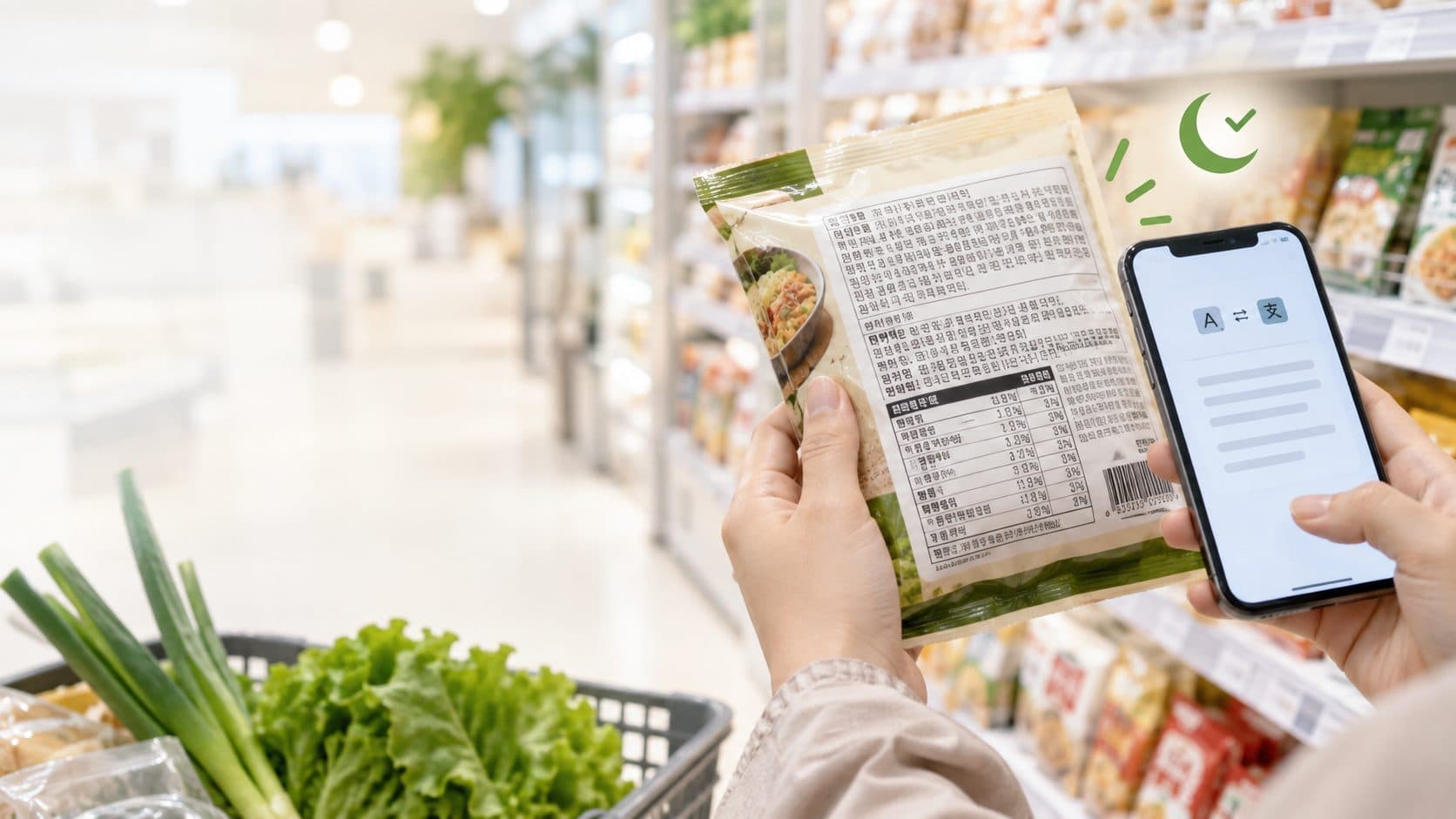
Buying groceries in Korea becomes much easier once you know where to look on the label. The most important section is 원재료명, the ingredient list. For Muslim shoppers, however, reading the ingredients is only the first step: a product without an obvious pork ingredient is not automatically halal, and labels such as HACCP, vegan or “pork-free” do not replace halal certification.
This guide explains the Korean words you are most likely to see, the ingredients that should stop you immediately, and the ingredients that require further verification.
The quickest way to check a Korean food label
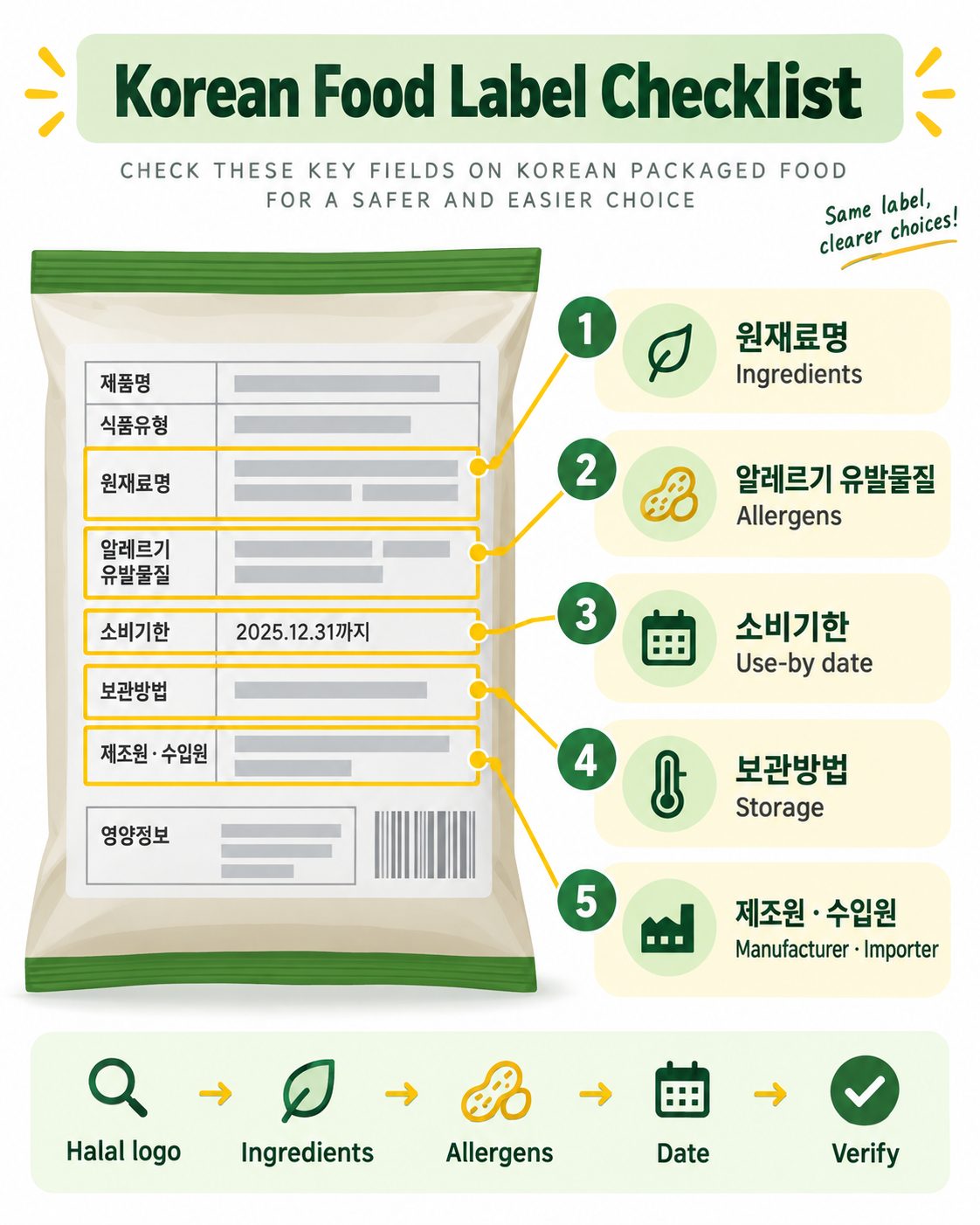
Use this five-step check before buying:
1. Look for a recognized halal certification mark and confirm that it applies to the specific product.
2. Read 원재료명 for pork, lard, alcohol and animal-derived ingredients.
3. Check 알레르기 유발물질 because pork, beef and chicken may appear in the allergen statement even when they are easy to miss in a long ingredient list.
4. Check 소비기한 and 보관방법 so the food is still suitable to eat and stored correctly.
5. If an ingredient source is unclear, contact the manufacturer or importer rather than guessing.
Essential Korean label words
Korean | English meaning | Why it matters |
제품명 | Product name | Identifies the product |
식품유형 | Food type | Shows the regulatory category, such as sauce or processed meat |
원재료명 | Ingredients | The main section for halal screening |
원산지 | Country or place of origin | Shows where an ingredient or product originated |
내용량 | Net quantity | Shows weight, volume or item count |
소비기한 | Use-by date | The date by which the food should be consumed when stored as directed |
품질유지기한 | Best-quality period | Used for certain foods where quality, rather than immediate safety, is the main issue |
제조일자 or 제조연월일 | Manufacturing date | Shows when the product was made |
보관방법 | Storage instructions | Look for room-temperature, refrigerated or frozen storage |
영양정보 | Nutrition information | Shows calories and major nutrients |
알레르기 유발물질 | Allergens | May reveal milk, egg, pork, beef, chicken and other ingredients |
수입원 or 수입판매업소 | Importer | Useful when asking about an imported product |
제조원 | Manufacturer | Useful when requesting ingredient-source confirmation |
Korean labels often use 실온보관 for room-temperature storage, 냉장보관 for refrigerated storage and 냉동보관 for frozen storage.
Ingredients that clearly require avoidance
The following terms indicate pork or common alcoholic cooking ingredients:
Korean term | Meaning |
돼지고기 or 돈육 | Pork |
돈지 | Pork fat |
라드 | Lard |
돈골 | Pork bone |
돈골농축액 or 돈골엑기스 | Pork-bone concentrate or extract |
베이컨 | Bacon |
햄 | Ham, although the exact meat should still be checked |
소시지 | Sausage; check the meat and casing |
주정 | Ethyl alcohol used as an ingredient or processing material |
미림 | Mirin-style cooking seasoning |
맛술 or 요리술 | Cooking wine |
청주 | Rice wine |
소주 | Soju |
럼, 브랜디, 와인 | Rum, brandy or wine |
If any of these appear, do not rely on the product name or front-of-package marketing. Read the full Korean sticker on imported foods as well.
Ingredients that require verification
Some Korean ingredient names do not reveal whether their source is plant, fish, cattle, pork or synthetic. These are not automatically haram, but they should be verified when the product is not halal-certified.
Korean term | Why the source matters |
젤라틴 | Gelatin may come from fish, cattle or pigs |
유화제 | Emulsifiers may be plant-derived or animal-derived |
쇼트닝 | Shortening may contain vegetable or animal fat |
글리세린 or 글리세롤 | Glycerin or glycerol may have plant, animal or synthetic origins |
효소 | Enzymes may come from microbial, plant or animal sources |
향료 | Flavoring may contain unclear carriers or processing ingredients |
육수, 육즙 or 고기엑기스 | Stock, meat juice or meat extract requires the animal species and slaughter source to be checked |
동물성 유지 | Animal fat; the animal source is not stated by this term alone |
복합조미식품 | Compound seasoning; check its sub-ingredients when listed |
For meat ingredients, 소고기 or 쇠고기 means beef and 닭고기 means chicken. The species may be acceptable, but many Muslim consumers will also require confirmation of halal slaughter and handling.
Use the allergen statement as a second check
Korean packaged foods may show a separate allergen statement using wording such as 알레르기 유발물질 or ○○ 함유, meaning “contains.” Korea’s mandatory allergen framework includes ingredients such as egg, milk, peanuts, soy, wheat, pork, chicken, beef, shrimp, crab and several other foods.
This section is useful because it can quickly expose 돼지고기 함유 (contains pork), 쇠고기 함유 (contains beef) or 닭고기 함유 (contains chicken). However, it is an allergy warning, not a halal declaration. It also does not replace the complete ingredient list.
You may also see 같은 제조시설에서 제조, meaning that the product was made in a facility that also handles the listed ingredient. This is a cross-contact warning. Consumers should follow their own halal standard and ask the certifier or manufacturer when the risk is unclear.
Understanding dates on Korean food
The most common date term is now 소비기한, or use-by date. Check it together with the stated storage method: a refrigerated product is only expected to remain suitable through that date when it has been continuously refrigerated as directed.
Do not confuse these terms:
· 제조일자 is the manufacturing date.
· 소비기한 is the use-by date under the stated storage conditions.
· 품질유지기한 is a quality-maintenance date used for eligible products.
Imported products normally carry a Korean-language label. If the original package and the Korean sticker appear inconsistent, ask the importer before consuming the product.
Halal certification, HACCP and vegan labels
These labels answer different questions:
· Halal-certified: A certifying body has reviewed the product and relevant production controls according to its halal standard. Check the certifier, product name and certificate validity when possible.
· HACCP: A food-safety management system. It does not certify that ingredients or processing are halal.
· Vegan or 비건: Indicates that the product follows a stated vegan standard. It can be a useful screening clue, but it may not address alcohol, shared facilities or every requirement of a halal standard.
· Pork-free: Means no pork is claimed. It does not confirm halal meat, alcohol-free formulation or certified production.
A halal logo should not be judged only by appearance. When the product is unfamiliar, identify the certifying organization and verify the certification through the certifier or supplier.
A practical decision rule
Buy with greater confidence when the exact product has a recognized halal certification, the certificate is current, and the package matches the certified product.
Verify before buying when there is no certification and the label contains gelatin, emulsifier, shortening, glycerin, enzymes, flavoring, meat extract or another ingredient with an unclear source.
Avoid when the label lists pork, pork fat, lard, pork-bone extract, cooking wine or another clearly prohibited ingredient.
Useful questions to ask in Korean
· 이 제품은 할랄 인증을 받았나요?
Is this product halal-certified?
· 할랄 인증서를 확인할 수 있을까요?
May I see the halal certificate?
· 젤라틴은 어떤 원료로 만들었나요?
What is the gelatin made from?
· 유화제는 식물성인가요, 동물성인가요?
Is the emulsifier plant-derived or animal-derived?
· 돼지고기나 라드가 들어 있나요?
Does it contain pork or lard?
· 주정이나 맛술 등 알코올 성분이 들어 있나요?
Does it contain alcohol ingredients such as ethyl alcohol or cooking wine?
· 고기 원료는 할랄 도축된 고기인가요?
Is the meat ingredient from halal-slaughtered meat?
Before adding it to your cart
· Check the exact product, not only the brand.
· Read the Korean sticker on imported foods.
· Check both 원재료명 and the allergen statement.
· Treat HACCP, vegan and pork-free claims as screening information, not halal certification.
· Save a photo of the label when asking the seller or manufacturer.
· When the answer remains uncertain, choose a clearly certified alternative.
Fornur aims to make international and halal grocery shopping easier for foreign residents in Korea. Product formulations and certificates can change, so always check the package delivered to you and contact Fornur if you need help understanding a label.
Official references
· Korean Ministry of Food and Drug Safety Imported Food Information Maru Korean labeling fields
· Korean National Law Information Center Food Labeling Standards detailed criteria
· MFDS guide to checking imported-food date and Korean label information
This guide provides general shopping information, not a religious ruling or medical allergy advice. Follow the halal standard you trust and seek professional advice for serious food allergies.
How This Guide Was Prepared
This guide is designed to help foreign residents and visitors understand common questions before making a decision. Details should always be confirmed directly with the relevant provider or an appropriately qualified professional.
- Author
- Lucky_Nomad991
- Last reviewed
- September 16, 2026