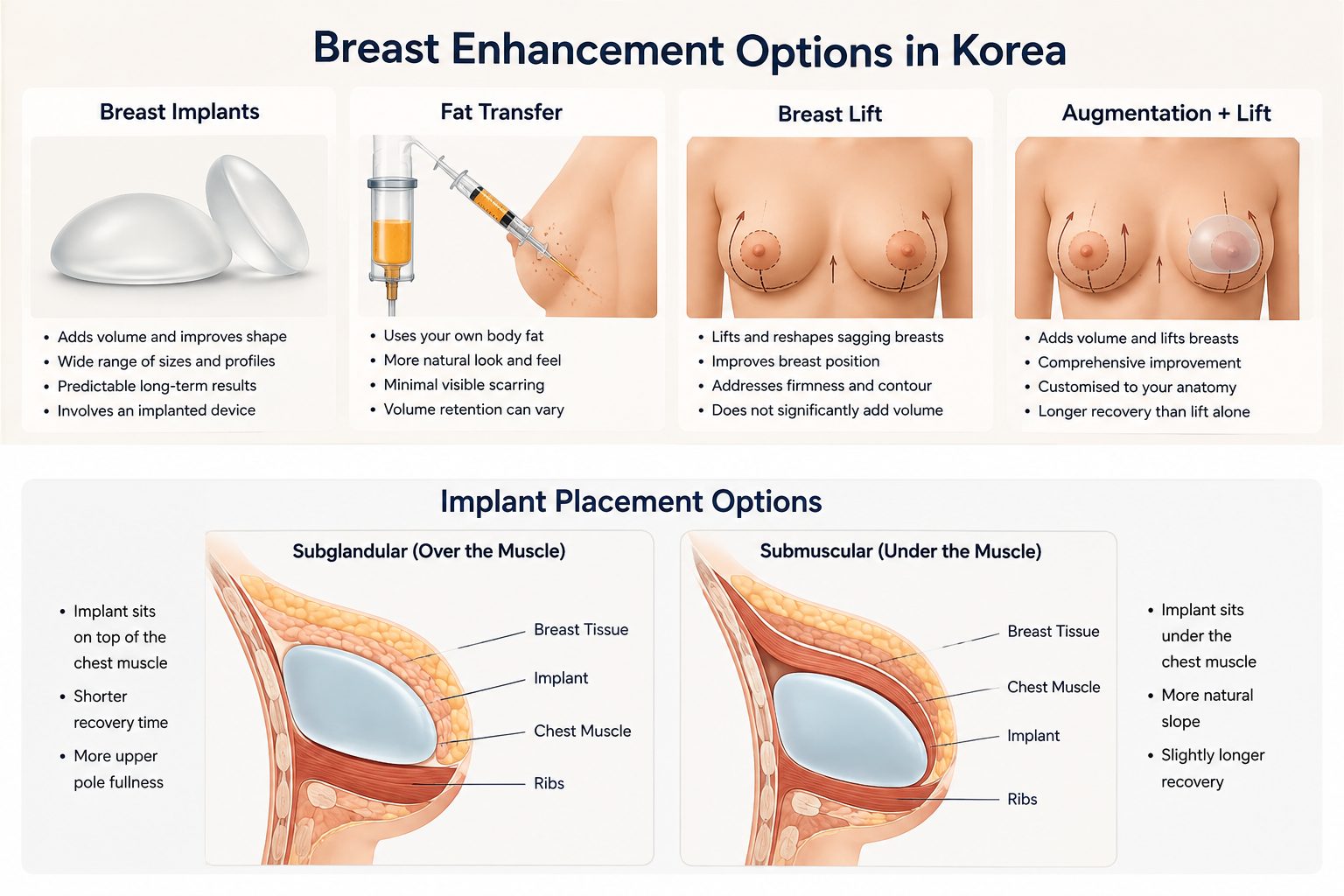


Search for “breast enhancement Korea” and the first decision can look like a choice between implant brands. In reality, the bigger question comes earlier: are you comparing implants, fat transfer, a breast lift, or a combination?
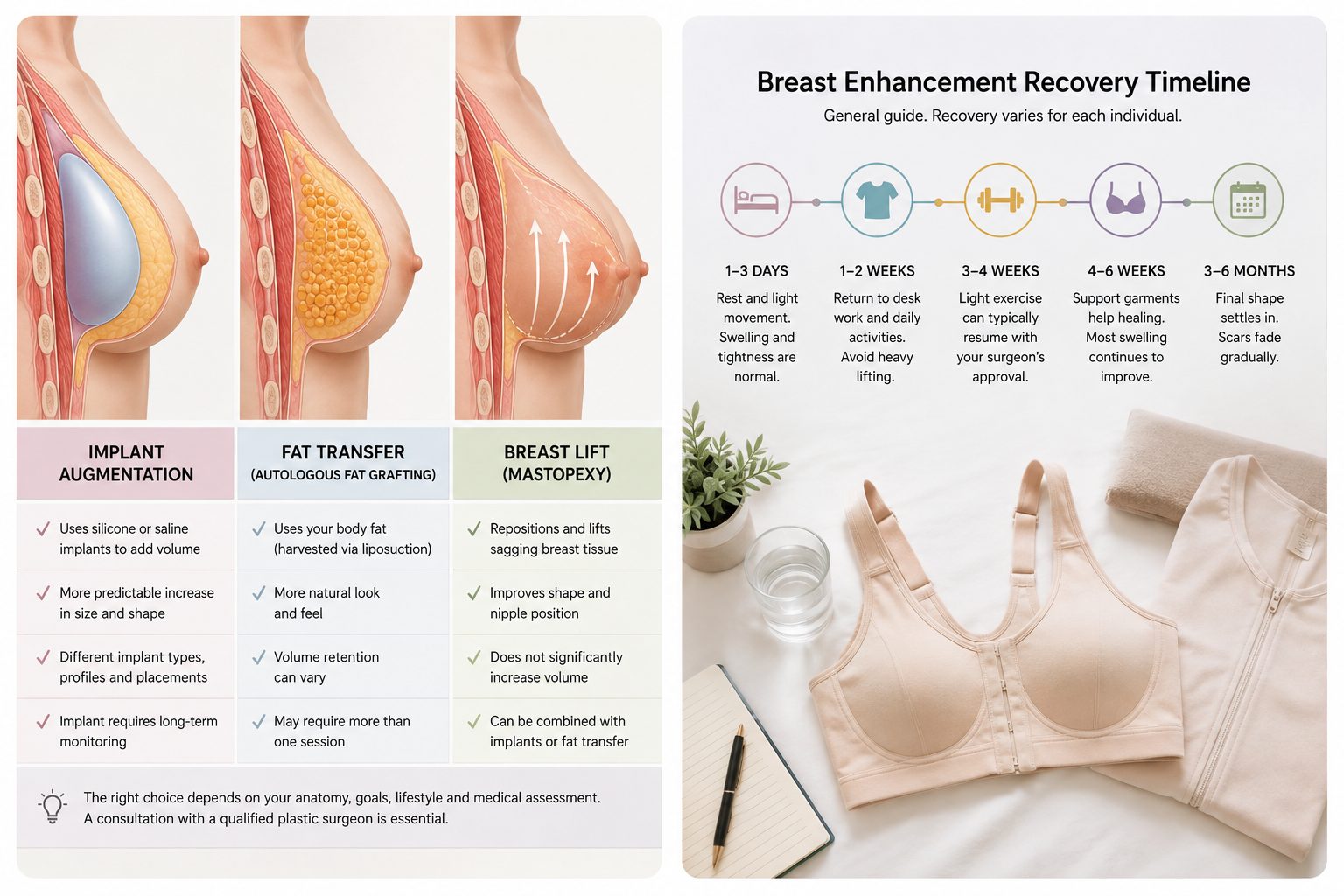
Those procedures solve different problems. Implants add a medical device to increase volume and projection. Fat transfer moves your own fat from another body area into the breast. A breast lift primarily repositions sagging tissue and does not create the same type of volume increase.
For an international patient, the long-term plan matters as much as the operation itself. Implant monitoring, future revision, fat-graft retention, scar care and access to the surgeon after you leave Korea all belong in the decision.
This guide explains the main breast-augmentation options, what changes the quote, how to compare implant and fat-transfer plans, what recovery involves and which safety questions should be answered before you pay a deposit.
Comparing breast augmentation options in Korea? Start with the procedure you are actually considering and the complete long-term plan — not a brand name, cup-size promise or package price. Fornur can help you explore current Beauty & Medical services and request a consultation with an available partner. |
Quick Answer
Breast augmentation in Korea can use breast implants, autologous fat transfer or, in selected plans, a combination of the two.
The appropriate route depends on anatomy, desired degree of volume change, skin and tissue characteristics, donor fat, previous breast surgery and how you feel about long-term implant monitoring.
A breast lift is different. It primarily addresses drooping or nipple/breast position and may be performed alone or combined with augmentation when both position and volume need to change.
Key Takeaways
Breast enhancement Korea is a broad search term. Clarify whether the plan is implants, fat transfer, lift, or a combination before comparing prices.
Implants can provide a more defined and predictable volume increase, but they are medical devices that require long-term monitoring and may need revision or removal later.
Fat transfer avoids a breast implant but requires liposuction, depends on donor fat and has variable volume retention.
A breast lift is not simply a more expensive augmentation. It addresses tissue position and may be needed when sagging is the main concern.
Do not choose an implant solely by brand, shape or social-media trend. Ask about the exact device, surface, fill, size/profile, placement and why it fits your anatomy.
International patients should plan for early follow-up in Korea and a realistic long-term care route after returning home.
Breast Enhancement Korea: What Procedures Does the Search Actually Cover?
The American Society of Plastic Surgeons defines breast augmentation as increasing breast size using implants or fat transfer. That is the useful clinical starting point for a broad search like breast enhancement Korea.
ASPS breast augmentation overview
The main options are not interchangeable. One introduces an implant, one moves living fat, and a breast lift primarily changes tissue position. A combined plan may address more than one concern, but each component should have a clear reason.
Procedure | What it generally changes | Main planning question |
Implant augmentation | Adds breast volume and projection using a medical device. | What exact implant, size/profile, placement and incision plan are being proposed, and why? |
Fat-transfer augmentation | Uses liposuction to harvest fat and inject selected processed fat into the breast. | How much donor fat is available, what degree of change is realistic and how will volume retention be assessed? |
Breast lift (mastopexy) | Repositions sagging breast tissue and nipple/areola position; may remove excess skin. | Is sagging the main problem, and is augmentation actually needed in addition to lift? |
Augmentation + lift | Adds volume while also repositioning tissue. | Why are both procedures needed and how does combining them change scars, recovery and revision risk? |
Implant + fat transfer | Uses an implant for core volume with fat grafting for selected contour goals. | What does each component contribute, and what donor-site surgery is required? |
Breast Implants vs Fat Transfer: What Is the Real Difference?
Implants and fat transfer can both increase breast volume, but they behave very differently over time.
Implant augmentation uses a manufactured medical device placed in a surgical pocket. Fat transfer uses liposuction to remove fat from another body area, processes it and injects selected fat into the breast.
Decision point | Breast implants | Fat transfer |
Volume change | Can provide a larger and more predictable single-operation increase, depending on anatomy and device selection. | Usually better suited to a more modest or targeted increase; total change is limited by donor fat and graft survival. |
Material | A saline- or silicone-filled implant depending on device availability and jurisdiction. | The patient’s own fat harvested by liposuction. |
Long-term issue | Implant integrity, capsule formation, device-related complications and possible future revision/removal. | Variable fat retention, fat necrosis/cysts/calcification and possible staged grafting. |
Donor-site surgery | Not required for the augmentation itself. | Required because fat must be harvested elsewhere. |
Monitoring | Implants require ongoing follow-up; silicone implant rupture can be silent. | No implant-integrity surveillance, but breast health and radiologic changes still need appropriate assessment. |
Best question | Why this exact implant and pocket plan for my chest and tissue? | How much stable volume change is realistic after the transferred fat settles? |
A 2024 systematic review of autologous fat grafting for breast augmentation found that volume retention varies and that fat necrosis is an important complication to consider. A 2025 network meta-analysis also found that graft-survival outcomes depend partly on technique, reinforcing that fat transfer is not a fixed-volume substitute for an implant.
2024 systematic review of breast fat grafting · 2025 network meta-analysis of breast fat grafting strategies
Breast Implants: What Should You Compare Beyond the Brand?
Implant brand is only one part of the surgical plan. Device fill, shell surface, shape, dimensions, profile and size all need to be considered alongside your chest width, breast tissue and desired change.
The implant pocket matters too. ASPS describes placement either behind breast tissue or under the pectoral muscle, with the exact approach depending on the implant, anatomy and surgeon’s recommendation.
ASPS breast augmentation procedure steps
What is the exact implant manufacturer and model?
What are the fill material, shell surface, shape, dimensions and profile?
Why does this implant fit my chest width and soft-tissue coverage?
Where will the implant be placed relative to the pectoral muscle?
Where will the incision be and what scar should I expect?
What device card or implant record will I receive after surgery?
What is the clinic’s plan if the implant ruptures, contracts, moves or needs revision later?
Do not import US FDA approval into Korea. US FDA information is useful for understanding breast-implant safety principles, but the Korean regulatory status and current availability of the exact implant must be confirmed separately with the clinic.
Silicone Implant Monitoring: Plan Beyond the Korea Trip
Breast implants are not lifetime devices. ASPS and FDA materials both emphasise that some patients will need revision, removal or replacement later because of complications or changing anatomy.
FDA things to consider before getting breast implants
For asymptomatic silicone gel-filled implants, current US FDA labelling guidance recommends a first ultrasound or MRI 5–6 years after implantation and then every 2–3 years. That is US guidance rather than a Korean surveillance rule, but it shows why long-term monitoring should be discussed before surgery rather than after you return home.
FDA breast-implant labelling guidance
Ask the Korean surgeon what follow-up applies to the exact device you are receiving, what records you should keep and who should review the implant if you later live in another country.
Fat Transfer Breast Augmentation: What Should You Understand First?
Fat-transfer breast augmentation is two procedures in one: fat is harvested with liposuction from a donor area and then injected into the breast.
ASPS fat-transfer breast augmentation overview
The trade-off is that not all transferred fat remains permanently. Volume retention varies between patients and techniques, and additional treatment can be needed if the final volume is less than expected.
Risks can include infection, cysts, fat necrosis, calcifications and loss of part of the transferred volume. The donor site also has its own liposuction-related recovery and risks.
ASPS fat-transfer breast augmentation risks
Breast Lift Korea vs Breast Augmentation: Which Problem Are You Trying to Solve?
A breast lift and breast augmentation answer different questions. Augmentation adds volume; a lift repositions sagging tissue and can raise the nipple/areola position.
ASPS notes that augmentation alone does not correct severe breast drooping. Some patients need a lift alone, while others may discuss lift plus augmentation if both position and volume are concerns.
If your main complaint is sagging after pregnancy, weight change or ageing, do not assume a larger implant is the solution. Ask whether adding volume without correcting tissue position would actually address the concern.
Breast Enhancement Korea Cost: What Changes the Quote?
There is no defensible single country-wide price for breast enhancement in Korea. The total changes with the procedure, implant or fat-transfer plan, surgeon, facility, anaesthesia, tests, garments, medicines and follow-up.
ASPS cost guidance is useful for the structure of a quote because it separates the surgeon fee from anaesthesia, operating-facility and related expenses. US dollar averages should not be imported into Korea.
ASPS breast augmentation cost framework
Cost component | What to confirm before paying |
Procedure | Implant augmentation, fat transfer, lift, hybrid plan or revision. |
Implant / material | Exact implant manufacturer/model or fat-transfer scope; ask whether device cost is included. |
Surgeon | Named operating surgeon and their relevant breast-surgery experience. |
Facility & anaesthesia | Hospital/operating facility, anaesthesia type and the professional responsible. |
Tests / imaging | Preoperative blood tests, breast imaging or other medical clearance when required. |
Postoperative items | Support garment, medicines, dressings, drain care if used and routine follow-up. |
Revision / complication policy | What happens financially and clinically if a revision or implant problem occurs. |
International support | Interpretation, transport or coordination only when explicitly included in writing. |
Searches such as breast augmentation Korea price, breast implants Korea price and breast augmentation Korea cost are useful only when the quote identifies the exact surgery and inclusions. A package price without the surgeon, device, facility, anaesthesia and aftercare is not a like-for-like comparison.
Need an itemised breast-augmentation consultation? Ask the clinic to confirm the exact procedure, implant or fat-transfer plan, surgeon, facility, anaesthesia, follow-up and complete written price before you commit to travel or a deposit. |
Before-and-After Photos: How to Compare Breast Augmentation Results
Compare patients with a similar starting breast shape, tissue coverage and degree of asymmetry.
Confirm whether the case used implants, fat transfer, a lift or more than one procedure.
Ask which implant or fat-transfer plan was used; a photo without procedure details is incomplete.
Look at front, oblique and side views with similar posture and lighting.
Ask when the postoperative photo was taken because swelling, implant position and scars continue to change.
Use photos to discuss realistic proportions, not to request an identical cup size or breast shape.
What Should Happen During a Breast Augmentation Consultation?
ASPS consultation guidance recommends discussing goals, medical conditions, medicines and supplements, smoking/alcohol/drug use, family breast-cancer history and previous breast imaging or biopsies.
ASPS breast augmentation consultation guidance
The surgeon should measure the breasts and chest, assess asymmetry and tissue coverage, discuss the incision and pocket plan, and explain whether augmentation alone can meet the goal.
Why do you recommend implants, fat transfer or a combination for me?
What exact implant or fat-transfer strategy would you use and why?
Do I need a breast lift as well, and what finding supports that?
Which hospital or surgical facility will be used?
What anaesthesia is planned and who is responsible for it?
What are the important short- and long-term risks for this exact plan?
What implant card, operative records and imaging information will I receive?
What follow-up will happen in Korea and after I return home?
Breast Augmentation Recovery: Plan for the Operation and the Trip
Early implant-augmentation recovery commonly includes soreness, swelling and activity restriction. ASPS notes that acute pain often improves over several days while soreness and swelling can continue for weeks, and return to exercise should follow the surgeon’s instructions.
ASPS breast augmentation recovery guidance
Fat-transfer recovery also includes the donor area, because liposuction is part of the procedure. That can change mobility, garment use and how comfortable travel feels.
Do not judge the final implant position, breast softness or scar appearance in the first days after surgery. ASPS notes that swelling takes time to settle and incision lines continue to mature.
ASPS breast augmentation results guidance
Breast Implant Risks: What Deserves a Direct Conversation?
Breast augmentation is major surgery. Risks include bleeding, infection, seroma, changes in breast or nipple sensation, scarring, persistent pain, implant malposition, rupture or leakage, visible rippling and capsular contracture.
ASPS breast augmentation risks and safety
Capsular contracture occurs when the scar capsule around an implant tightens and changes the feel or shape of the breast; it is an important reason for revision after augmentation. A 2024 systematic review highlights that management remains surgical in many clinically significant cases.
2024 systematic review of capsular contracture management
BIA-ALCL, Implant Surface and Systemic Symptoms
The FDA states that breast implant-associated anaplastic large cell lymphoma (BIA-ALCL) is a rare lymphoma that can develop in the capsule or fluid around an implant, and that risk is higher with textured implants than smooth implants.
FDA BIA-ALCL questions and answers
Ask the clinic to identify the exact implant surface and the current Korean regulatory status of that device. Do not rely on the word “premium” as a safety category.
Some patients with implants also report systemic symptoms often grouped under the term breast implant illness (BII), such as fatigue, cognitive symptoms, muscle or joint pain. The condition remains complex and mechanisms and diagnostic criteria are still being studied; symptoms should be medically evaluated rather than assumed to have one cause.
2025 systematic review of breast implant illness
When Can You Fly Home After Breast Surgery in Korea?
The NHS gives a general recommendation not to fly for 5–7 days after procedures such as breast surgery because both surgery and air travel increase blood-clot risk.
NHS guidance on cosmetic surgery abroad
That is broad guidance, not individual medical clearance. Breast augmentation can require a longer stay depending on the operation, pain control, mobility, wound review, drains if used, complications and your surgeon’s follow-up schedule.
Before purchasing a non-refundable flight, ask when the surgeon wants to review you, which symptoms would delay travel and how urgent care would work once you leave Korea.
Planning South Korea Breast Augmentation as an International Patient
International planning should include more than surgery day. Confirm the exact facility, surgeon, implant/device record, aftercare, emergency contact and how records will be transferred if you need treatment in another country later.
Medical Korea maintains an official directory of institutions registered to serve foreign patients. Registration is a useful verification step, but it is not a guarantee of a cosmetic result.
Medical Korea Registered Hospitals directory
Before paying a deposit | Before surgery | Before leaving Korea | Long-term |
Confirm the exact operation, surgeon, implant or fat-transfer plan, total price, cancellation terms and recommended stay. | Confirm consent, implant/device details, imaging/tests, anaesthesia, postoperative garment and emergency contact. | Ask whether wounds and swelling are progressing as expected, what symptoms require urgent review and when flying is appropriate. | Keep the implant/device card and operation records; know how future implant monitoring, breast screening and revision care will be arranged. |
How Fornur Can Help You Compare Breast Enhancement Options
Fornur helps foreigners explore medical and beauty services in Korea, review clinic-provided treatment information and request consultations with available clinic partners.
A dedicated breast-augmentation listing was not verified in the current Fornur inventory when this guide was prepared, so current clinic availability should be confirmed rather than assumed.
When you enquire, include whether you are comparing implants, fat transfer, lift or revision; previous breast surgery; relevant breast imaging/history; preferred dates; and your planned departure date.
The clinic must still confirm the surgeon, exact procedure, implant/device or fat-transfer plan, suitability, facility, anaesthesia, recovery, long-term follow-up and complete price. The consultation request through Fornur can be free; surgery and related medical services are paid separately.
Ready to compare the complete plan? Request the exact procedure, surgeon, implant or fat-transfer details, itemised price, recovery schedule, long-term follow-up and travel guidance before you commit. |
Conclusion
The search “breast enhancement Korea” covers several different surgical plans. Implant augmentation, fat transfer and breast lift solve different problems, and the right comparison starts with the procedure rather than a brand name or package price.
If you are considering implants, understand the exact device, pocket plan, long-term monitoring and future revision implications. If you are considering fat transfer, understand donor-site surgery and the uncertainty of final retained volume. If sagging is the main concern, ask whether augmentation alone can actually solve it.
For international patients, recovery and long-term access to care are part of the treatment decision. The strongest consultation leaves you knowing the exact operation, surgeon, device or grafting plan, risks, complete cost, follow-up schedule and what happens if you need care after leaving Korea.
Explore Fornur’s Beauty & Medical services or request a free consultation to ask about current clinic availability and an itemised surgical plan.
Medical note: This guide provides general educational information. It does not diagnose a breast condition, select an implant, determine surgical suitability, recommend a clinic or surgeon, or replace an individual consultation with an appropriately qualified healthcare professional.
How This Guide Was Prepared
This guide is designed to help foreign residents and visitors understand common questions before making a decision. Details should always be confirmed directly with the relevant provider or an appropriately qualified professional.
- Author
- Mustafa
- Last reviewed
- August 23, 2026
Frequently asked questions
Free clinic consultation
Share your goals and let Fornur help review available clinic options.