
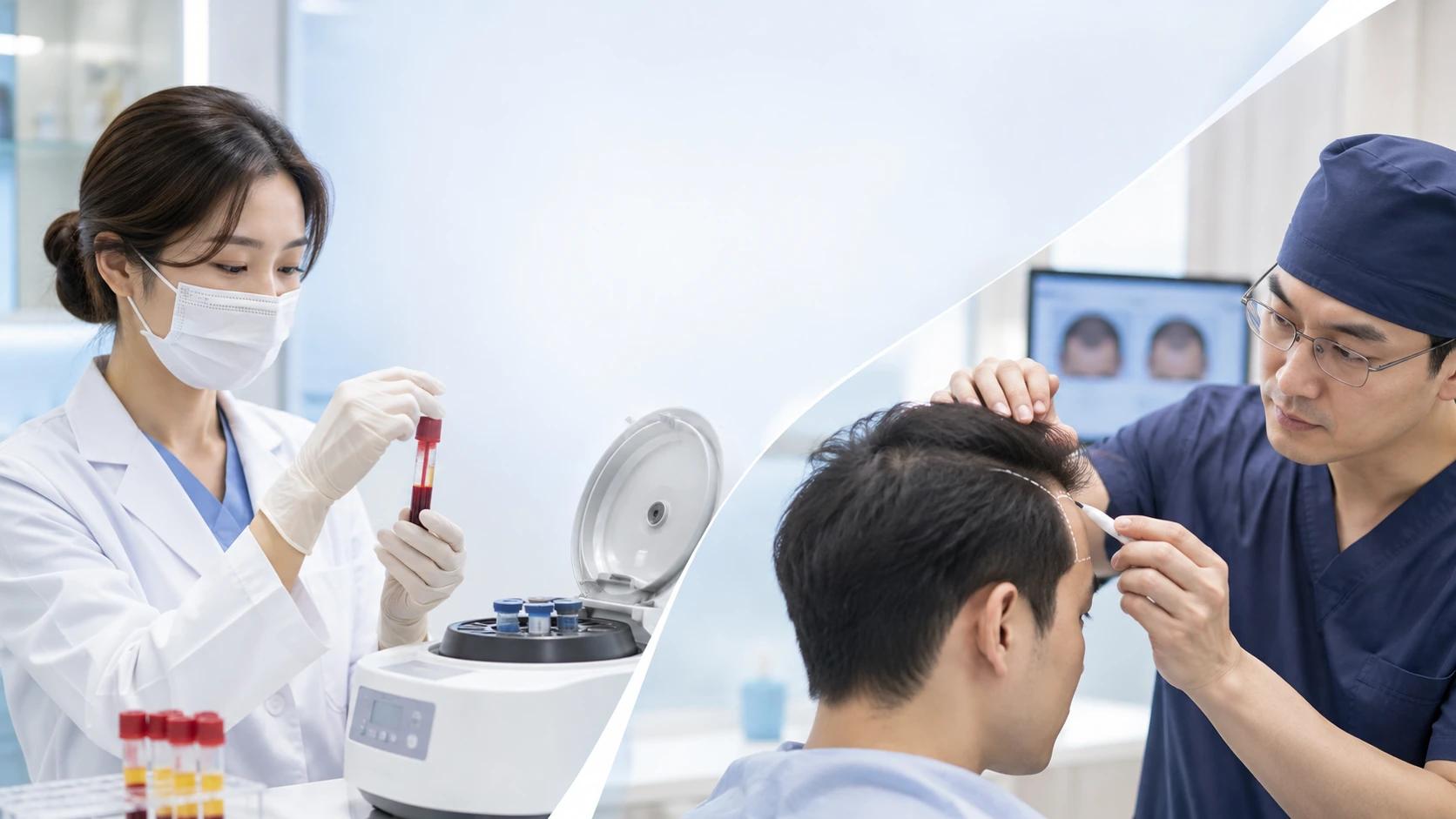
PRP vs hair transplant: which treatment is better if you're losing your hair?
It depends on whether your goal is to improve existing thinning hair or restore coverage where substantial loss has occurred.
Platelet-rich plasma (PRP) uses injections prepared from your own blood. It may improve hair density for selected patients with responsive follicles. A hair transplant surgically moves healthy follicles from a donor area into thinning or bald areas.
Quick answer: PRP may be worth discussing for some forms of early pattern thinning. Transplantation may be more relevant for established recession or selected bald areas when donor hair is adequate. Neither is universally better, and a specialist must identify the cause of hair loss first.
If you're comparing hair restoration in Korea, the differences in results, recovery, cost, risks and aftercare matter more than a promotional before-and-after photo.
PRP vs Hair Transplant: At a Glance
Comparison at a glance
How it works - PRP: Injects plasma prepared from the patient’s blood; Transplant: Moves healthy donor follicles into thinning or bald areas.
Typical consideration - PRP: Selected pattern thinning with responsive follicles; Transplant: Selected established hair loss with adequate donor supply.
Procedure - PRP: Blood collection and scalp injections; Transplant: Surgery and graft placement.
Results - PRP: Variable improvements in density; Transplant: Growth from surviving grafts over several months.
Sessions - PRP: Often a repeated course and possible maintenance; Transplant: One surgery or staged operations, plus follow-up.
Recovery - PRP: Usually limited injection-related downtime; Transplant: Early healing and graft protection commonly one to two weeks.
Major limitation - PRP: Cannot reliably rebuild areas without responsive follicles; Transplant: Finite donor supply, surgery risks and ongoing native-hair loss.
Cost structure - PRP: Per session or course; Transplant: Larger surgical and aftercare quotation.
Key distinction: PRP aims to improve growth from existing responsive follicles. Hair transplantation moves follicles to improve coverage. They are not interchangeable.
Want to compare procedures before deciding? Explore PRP Hair Treatment in Korea and FUE Hair Transplant in Korea. Eligibility and availability must be confirmed.
PRP Hair Treatment vs Hair Transplant: How Do They Work?
What is PRP hair treatment?
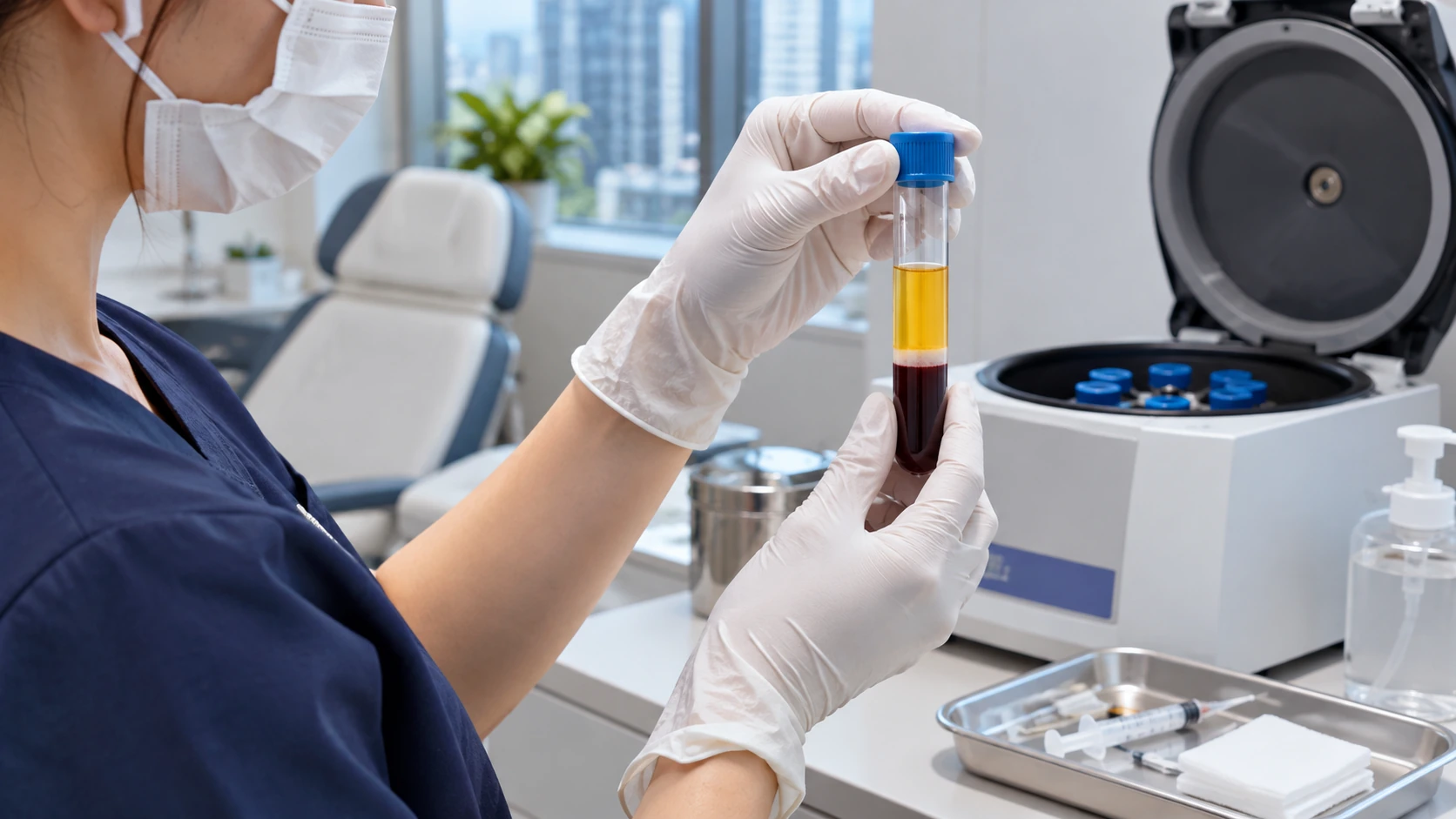
A clinician takes a blood sample, processes it to concentrate platelets in plasma, and injects the preparation into selected scalp areas. PRP has been studied most often for androgenetic alopecia, also called pattern hair loss.
A 2025 systematic review of 43 randomized trials involving 1,877 participants found potential benefits for hair density across alopecia studies, but preparation methods, diagnoses and protocols varied. It does not establish one universally effective PRP regimen, and results are not guaranteed.
PRP does not create an unlimited supply of new follicles. It is unlikely to restore meaningful coverage where functioning follicles are absent. The ISHRS patient overview of PRP provides additional background.
What is a hair transplant?
Hair transplantation surgically relocates healthy follicular units from a donor area, commonly the back or sides of the scalp, to an area needing coverage. The donor supply is finite.
FUE (follicular unit excision): Individual follicular units are removed, leaving many small extraction scars.
FUT (follicular unit transplantation): A strip of donor scalp is removed and divided into grafts, usually leaving a linear donor scar.
Both require surgical planning. The American Academy of Dermatology's hair-transplant guidance stresses adequate donor hair, individual suitability and realistic outcomes.
PRP vs FUE hair transplant: what changes?
FUE is a technique for harvesting and implanting donor follicles. PRP is an injection-based procedure and does not harvest or transplant follicles. The procedures address different goals and should not be compared using the same success-rate claim.
Hair Transplant vs PRP: Which Fits Your Hair-Loss Pattern?
Concern → Appropriate first discussion
Early pattern thinning → Diagnosis and medical treatment; PRP may be considered for selected patients.
Established receding hairline → Surgical suitability, donor evaluation and long-term hairline planning.
Large bald area → Surgeon-led donor-supply assessment; PRP is unlikely to replace absent follicular coverage.
Rapid or unexplained shedding → Dermatology assessment before selecting cosmetic treatment.
Possible scarring or inflammatory loss → Clinical diagnosis and disease management first.
Limited donor supply → Discuss limitations and alternative medical approaches.
These are pathways for a medical discussion, not self-diagnosis or treatment recommendations.
Is PRP better for early hair thinning?
PRP may be discussed for selected patients who still have responsive follicles. Medical treatment and the cause of thinning should be evaluated first. Depending on the diagnosis and patient, a clinician may discuss established options such as minoxidil or finasteride, including their risks and suitability.
PRP should not be presented as an automatic replacement for evidence-based medical management.
Does PRP work for a receding hairline?
PRP for a receding hairline may have a role where miniaturized follicles still respond. It is less likely to recreate a substantially lost hairline. Transplantation may be considered if sufficient donor hair is available, but stability, future thinning and age-appropriate hairline design matter.
Can PRP delay the need for a hair transplant?
Some patients may benefit from non-surgical management before a surgical decision, but there is no guarantee that PRP alone will prevent, postpone or replace transplantation. The diagnosis and long-term plan should determine timing.
When is neither PRP nor transplantation the right starting point?
Sudden shedding, patches, pain, inflammation or possible scarring hair loss call for dermatological assessment. Scalp examination, selected blood tests or biopsy may be appropriate. Read the AAD guidance on hair-loss diagnosis and treatment.
PRP vs Hair Transplant Results: What Can You Realistically Expect?
PRP results
Some people with pattern hair loss experience improvements in measured density or shedding after a treatment course. Others see limited benefit. Protocols and outcomes differ, so clinicians should assess change with consistent photographs and suitable hair measurements rather than promising a fixed number of new hairs.
Hair-transplant results
Transplanted hairs commonly shed before new growth emerges. The AAD notes that many patients see results around six to nine months, while some need longer. Outcome depends on graft survival, donor characteristics, hairline design, surgeon expertise and future thinning.
Neither procedure guarantees a particular density, a permanent cure for hair loss or an identical result for every patient.
Recovery, Sessions and Risks
Recovery, treatments and risks
Sessions - PRP: Often initial series plus reassessment; Transplant: Often one surgery, sometimes staged.
Early healing - PRP: Temporary injection-related symptoms; Transplant: Graft and donor-area care, often one to two weeks.
Results - PRP: Assess over several months; Transplant: Growth develops over months; some patients need more than a year for maturation.
Potential harms - PRP: Pain, swelling, bruising, bleeding or infection; Transplant: Infection, bleeding, scarring, graft failure, donor depletion or dissatisfaction.
Follow-up - PRP: Check response and whether further sessions are useful; Transplant: Surgical wound checks and longer-term graft assessments.
How many PRP sessions are needed for hair loss?
There is no universal schedule. Some protocols use an initial series of approximately three monthly sessions and subsequent reassessment. Before purchasing a package, ask how success will be measured, when to reassess and whether ongoing maintenance would be optional.
How long is recovery after a hair transplant?
Early healing and protection of grafts commonly require one to two weeks, although the surgeon's instructions and travel advice take priority. The NHS hair-transplant guide outlines recovery precautions and possible complications.
For the surgical details and graft-planning decisions, read Fornur's Hair Transplant in Korea guide.
PRP vs Hair Transplant Cost in Korea
A single PRP appointment generally has a lower initial fee than transplantation, but a PRP course may involve multiple visits and maintenance. A transplant is a larger surgical commitment with its own consultation, procedure and aftercare fees. Compare the complete proposed plan, not just advertised starting prices.
Published Seoul clinic prices - checked November 2026
Published independent Seoul clinic prices - November 2026
PRP - ₩790,000 starting price at REPIC Clinic Gangnam; basic PRP Cell Booster for scalp/body; VAT excluded.
FUE transplant - ₩9,200,000 at Yoon Hairline Clinic; 3,000 individual hairs (not 3,000 grafts); VAT excluded.
These are distinct procedures and clinic examples, NOT directly comparable packages, national averages or Fornur quotes.
These are published examples from independent clinics and are not national averages, equivalent packages or confirmed Fornur partner rates. Both cited prices exclude VAT.
The PRP example is the clinic's basic scalp/body PRP Cell Booster, not a standardized hair-loss protocol. The FUE example is priced for 3,000 individual hairs, not 3,000 follicular grafts. Ask providers to define exactly what a quoted unit means.
Sources: REPIC Clinic's published PRP pricing and Yoon Hairline Clinic's hair-transplant prices.
What should a complete quote include?
For PRP: Blood processing method, number of visits, any optional add-ons, review criteria, repeat sessions and VAT.
For transplantation: Hair or graft count, technique, surgeon's role, anesthesia, operating facility, medications, review visits, complication support and VAT.
Comparing costs in Seoul? Ask Fornur about current hair-treatment availability and what a participating provider would need to prepare an itemized quotation. An enquiry does not guarantee service availability, pricing or a booking.
PRP After Hair Transplant: Is It Necessary?
No. PRP after hair transplantation is not mandatory for every patient. Some clinics offer it before, during or after surgery as an optional adjunct intended to support growth or recovery.
A 2025 systematic review of PRP used with hair transplantation included only three controlled clinical studies involving 217 people. Results were encouraging in some outcomes, but the small evidence base, differing protocols and follow-up limitations prevent treating PRP as a required add-on.
Should you pay for PRP after surgery?
Ask what specific benefit the surgeon expects in your case and which evidence supports the proposed protocol.
Ask whether PRP is optional, when it would be given, how outcomes would be measured and what extra fees apply.
Ask what the standard postoperative plan includes if you do not choose PRP.
The surgeon - not a generic online calendar - should decide whether and when scalp injections are appropriate after transplantation.
How to Choose a PRP or Hair Transplant Clinic in Seoul
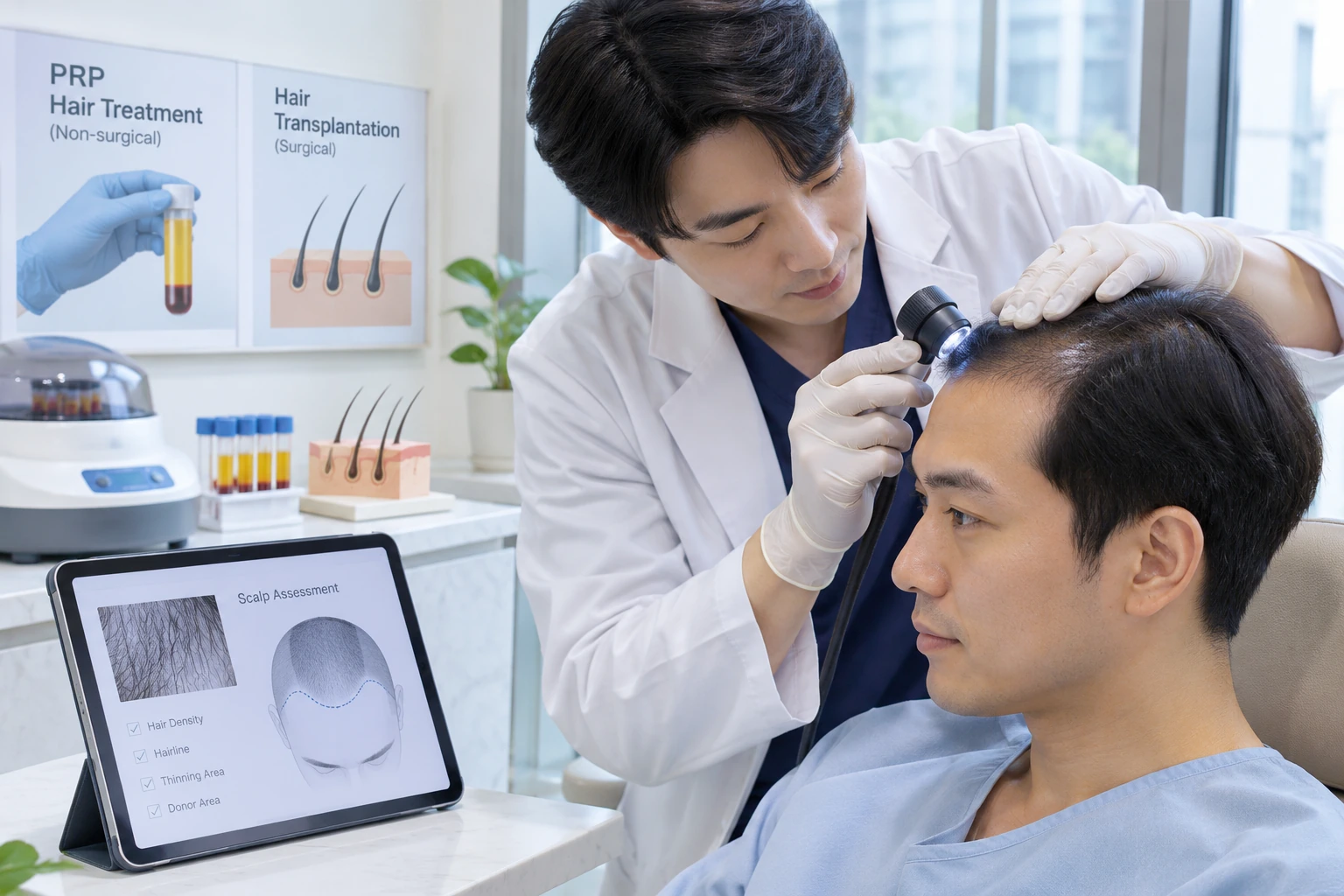
Before paying a deposit or arranging travel, ask the treating provider to explain the diagnosis, realistic treatment goal, alternatives, risks, all-in fees and the plan for care after you return home.
What condition is causing the hair loss, and is it stable?
Are we aiming to preserve existing hair or rebuild lost coverage?
Why is PRP, FUE, FUT or a different treatment being recommended?
Who performs the injections or each surgical step, including donor harvesting and recipient-site creation?
How are hairs or grafts counted, and what is included in the total price?
Which follow-up appointments and travel restrictions apply?
What happens if complications arise after leaving Korea?
The Medical Korea registered-hospitals directory can support institutional checks, but registration alone does not guarantee a particular outcome or replace verification of the clinician.
Which Treatment Should You Explore Next?
Thinning hair remains? Start with an assessment of cause and appropriate medical care; read the PRP Hair Treatment page for one potential option.
Established recession or bald area? Review FUE Hair Transplant in Korea to understand donor requirements and surgical recovery.
Unsure of the diagnosis? Start at Fornur's Hair Loss Treatment in Korea hub.
Ask Fornur About Hair Restoration Options
You do not need to decide between PRP and surgery before enquiring. Explain your main concern, previous treatment history and approximate travel dates.
Contact Fornur about current hair-treatment options. A clinician must confirm suitability, and Fornur must verify participating-provider availability, consultation arrangements, itemized price and any booking.
Final Verdict: PRP or Hair Transplant?
PRP may help selected patients improve existing density. Transplantation may restore coverage when adequate donor hair is available. They address different needs, and neither stops every form of future loss.
The right decision follows diagnosis, donor assessment, treatment goals, risk tolerance, total cost and follow-up arrangements - not a sales package.
Medical note: Educational information only. This article does not diagnose hair loss, prescribe treatment, predict results or replace consultation with a qualified clinician.
How This Guide Was Prepared
This guide is designed to help foreign residents and visitors understand common questions before making a decision. Details should always be confirmed directly with the relevant provider or an appropriately qualified professional.
- Author
- Mustafa
- Last reviewed
- November 25, 2026